Archives: Moteus

Compensating for FET turn-on time

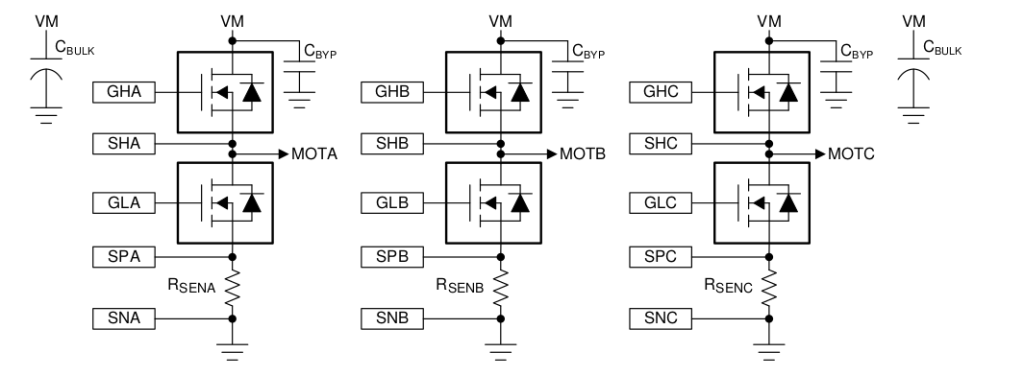
A motor driver like moteus switches power to the phases of a brushless motor using a set of 6 (or possibly more), MOSFETs. The typical topology involves 3 high side N channel MOSFETs and 3 low side N channel MOSFETs arranged in 3 half bridges like this:

(example 3 half-bridge from DRV8353 reference manual)

(example 3 half-bridge from DRV8353 reference manual)

Since the gates of these FETs need to be driven with potentially high voltages, and you never want the high side and low side to be on at the same time, typically a gate driver is used. For the moteus r4.5 and earlier controllers, the DRV8323 driver from Texas Instruments is what performs this function. This driver lets you configure the drive current for each of the gates for both operations, charging up the gate and discharging it. For high power drive systems, charging up or discharging the gate too fast can result in undesired transients like accidentally switching the other FET on due to capacitive coupling, or inductive ringing as the current starts moving through the FET instead of the body diode. If the gate charges too slowly, then the FET spends much of its time not fully on, which increases power dissipation in the FETs.

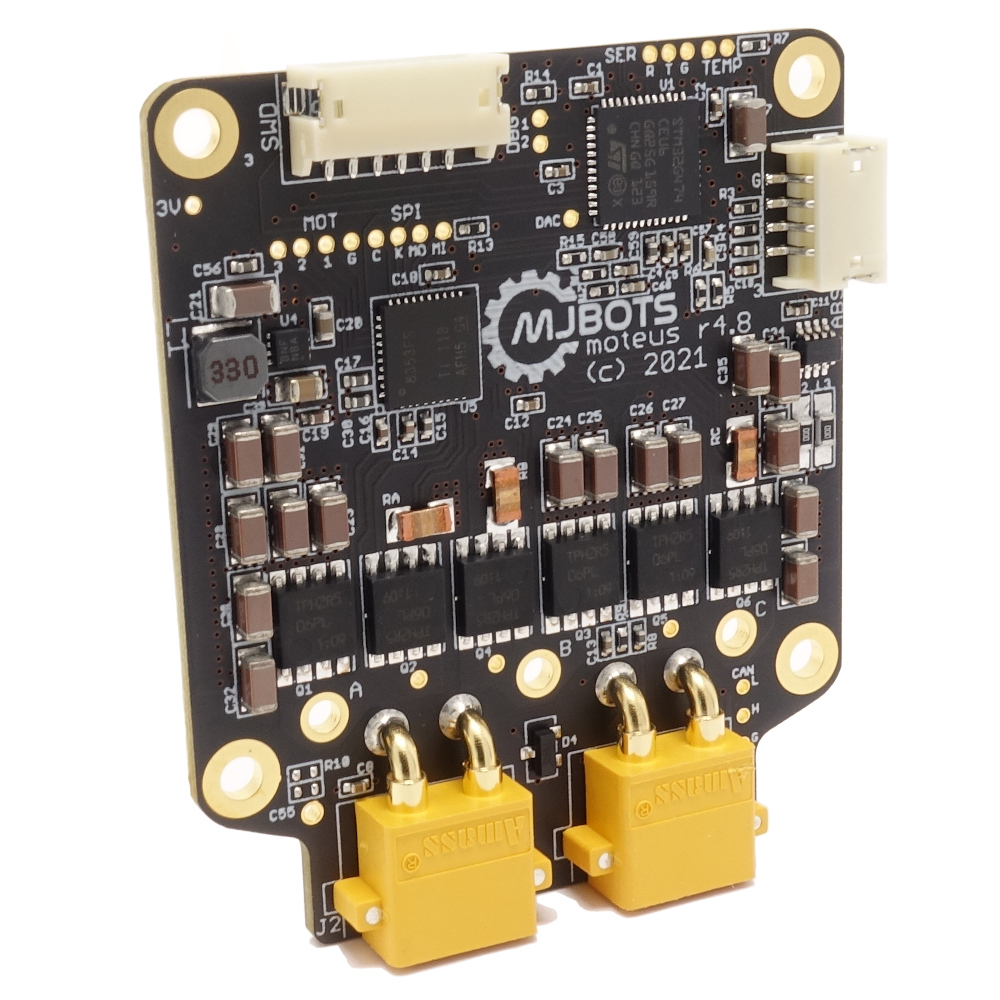
moteus r4.8

I’m excited to announce the release of moteus r4.8!

Due to the ongoing semiconductor apocalypse, this minor release uses some alternate components which were easier to source. It remains compatible with the r4.5 and r4.3 both electrically, mechanically, and with firmware.

For now, the biggest win is that the board and the devkit are actually in stock!

A secondary win is that external primary encoders are now supported, via an unpopulated connector pad on the backside of the board. I’ll write up more about that in a later post.

CAN prefixes for moteus

The moteus controller, communicates exclusively over CAN-FD for command, telemetry, and diagnostics. It will accept either standard or extended frames, and until now, the ID format in terms of bits looked like the following:

33333222222221111111100000000
43210765432107654321076543210
XXXXXXXXXXXXXQSSSSSSSDDDDDDDD

Where:

  • X: Don’t care
  • Q: 1 for query, 0 for no query
  • S: source ID
  • D: destination ID

If the lower 8 bits matched the configured ID, all the X bits would be completely ignored and moteus would accept the CAN message as if it were destined for itself. This may not be super desirable, as it consumes nearly all of the available CAN-FD addressing space.

Gear testing fixtures

The qdd100 servo uses a planetary geartrain as the transmission reducer. This consists of an outer ring gear, an inner sun gear connected to the rotor as the input, and 3 planets connected to the output. The tolerances of these gears directly impacts the performance of the servo, namely the backlash and noise.

To date, I’ve been hand-binning these and testing each servo for noise at the end of production. To make that process a bit more deterministic, and with less fallout, I’ve built up a series of manual and semi-automated gear metrology fixtures to measure various properties of the gears.

Filtering encoder values in moteus

TLDR: moteus can now filter the encoder, resulting in less audible noise. Use firmware version 2021-04-20 and ‘pip3 install moteus’ version 0.3.19, then re-calibrate to get the benefits.

Background

The moteus controller uses an absolute magnetic encoder to measure the position of the rotor. It uses this knowledge to accurately control the current through the three phases of a brushless motor so that the desired torque is produced, i.e. “field oriented control”. This works well, but has some downsides. One, is that magnetic encoders work by sensing the magnetic field produced by a “sensing magnet” that is somehow affixed to the rotor. This sensing process always introduces some noise, so that the sensed rotor position is never perfect.

moteus direction configuration

Since the first public release, moteus has always calibrated motors so that a positive command is equivalent to a fixed sequencing of the phase wires. That means that depending upon which order you solder the phase wires, a positive commanded velocity will result in the motor spinning either clockwise or counterclockwise.

As it turns out, since moteus has an absolute encoder that is immune to such vagarities, it is much more convenient to normalize the direction of rotation around the encoder rather than the phase wires. As of release 2021-04-26, and moteus_tool 0.3.22, that is exactly what moteus does.

Auxiliary encoders for moteus

The moteus controller uses an absolute magnetic encoder to sense the position of the rotor in order to conduct field oriented control of the motor. In many applications, this sensing is also sufficient to measure the output as well, particularly in direct drive applications. However, if the controller is driving the output through a gear reduction, multiple turns of the input are necessary to make one turn on the output. At power on, this results in an ambiguity, where the controller doesn’t know where the output is.

New available limits in moteus firmware

Some of the new features in the moteus 2021-04-09 firmware release are new limits that can make the overall system more robust to faults or environmental conditions.

Velocity limiting

config: servo.max_velocity

Like the position limits, there now is a configurable velocity limit. If the motor is moving faster than this limit in either direction, then the applied torque will be limited, eventually to a value of 0. This can be used to reduce the likelihood of runaway behavior in systems where high speeds are not expected.

Auto-tuning current control loops

Since the moteus controller was first released, it has implemented a two-stage controller. The outer loop is a combined position/velocity/torque PID controller, which takes as an input a position trajectory, and outputs a desired torque. The inner loops accepts this torque, and uses a PI controller to generate the Q phase voltage necessary to achieve that torque.

Until now, the constants for that PI controller were left as an exercise for the reader. i.e. there were some semi-sensible defaults, but the end-user ultimately had to manually select those constants to achieve a given torque bandwidth. That isn’t too much of a problem for a sophisticated user, but for the rest of us, it is hard to know how to go from a desired torque bandwidth to reasonable PI gains.