Archives: Fdcan

Bringing up the fdcanusb

I introduced the fdcanusb previously, now I’ll describe some of the process and challenges in getting it to work.

Hardware

My initial challenges were around the PCB design and manufacturing.  To begin with, my very first revision was sent out for manufacturing with the same incorrect pinout as the moteus controller r4.0 and thus was only really usable as a paperweight.  Second, the supply of STM32G474 chips seems to be spotty now, so for r2 I had to scavenge chips from the boards that had broken pinouts.

fdcanusb

One of the necessary pieces for bringing up the moteus brushless controller and for ongoing development with it is being able to communicate with the device on the desk.  There aren’t many options for desktop FDCAN communication currently, and certainly none that are in the affordable range occupied by the [CANUSB family of devices](http://CANUSB family of devices) which I’ve used before and was very happy with.  Thus I created “fdcanusb”, a USB to FDCAN converter that allows one to communicate with FDCAN devices via a USB interface using a documented protocol, no drivers necessary.

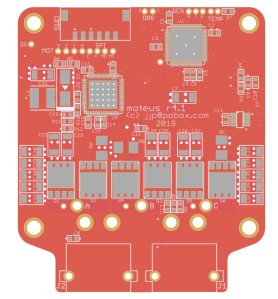
moteus controller r4.1

Another step in my plan for the next revision of the moteus servo mk2, is an updated controller board.  As mentioned in my roadmap, I wanted to revise this board to make improvements in a number of domains:

  • Communications: Now instead of RS485, the primary communications interface is FD-CAN.  This supports data rates of up to 8 Mbit and packet lengths up to 64 bytes.  The header is nominally at the original CAN bit rate, but I have no need to be standards compliant and am running very short busses so I may run everything at the higher rate.
  • Connectors: Now there exist power connectors, in the form of XT30 right angle connectors and they are also daisy chainable like the data connectors.  Additionally, all the connectors exit from the bottom of the board to make routing easier in configurations like the full rotation leg.
  • Controller: This uses the relatively new STM32G4 controller series.  It is lower power than the STM32F4, supports FD-CAN, and also supports closely coupled memory, which may allow me to improve the speed of the primary control loop execution by 3 times.
  • Voltage range: This board now has 40V main FETS, with all other components at 50V rating or higher.  Thus it should be safe with inputs up to 8S (34V or so).
moteus r4.1 rendering

moteus r4.1 rendering

Bringing up FD-CAN on the STM32G4

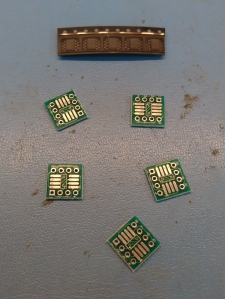
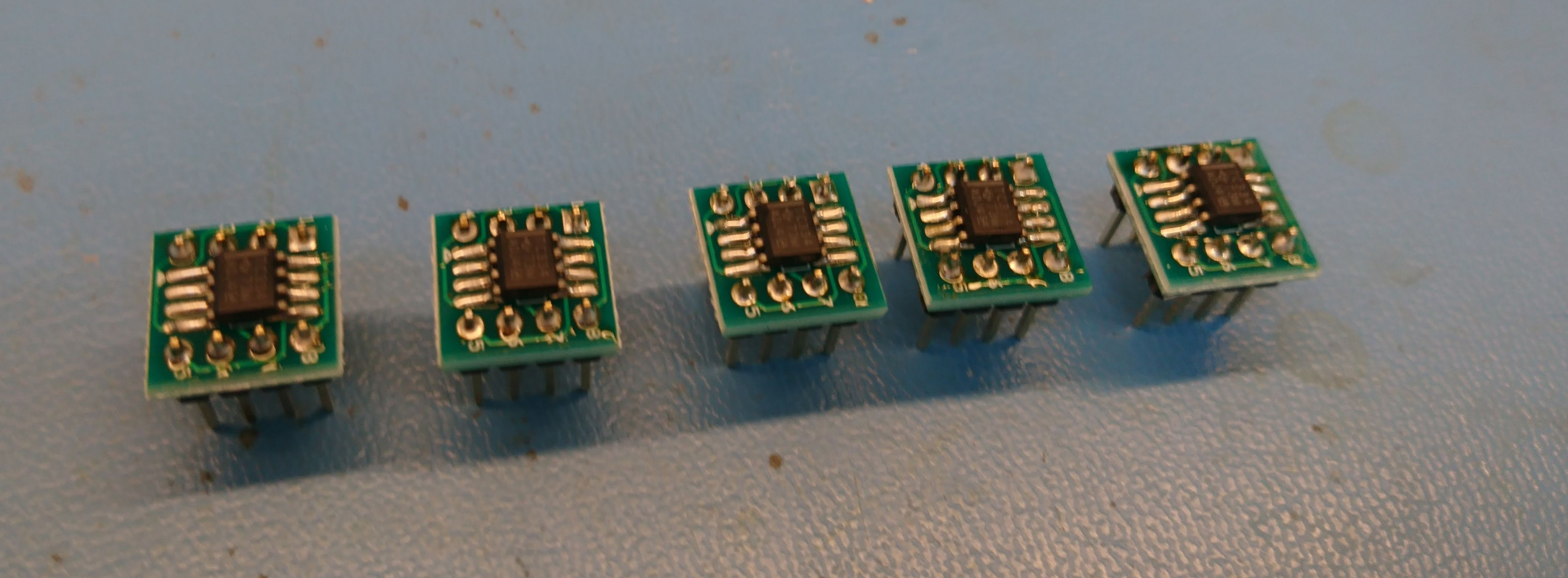
To verify that I could make FD-CAN work in the next revision of the moteus controller, I made a simple desk setup between two NUCLEO-G474RE boards.  I started by soldering up some breakout boards for the TCAN334G CAN transceiver I’m planning on using:

dsc_1549

dsc_1553.jpg

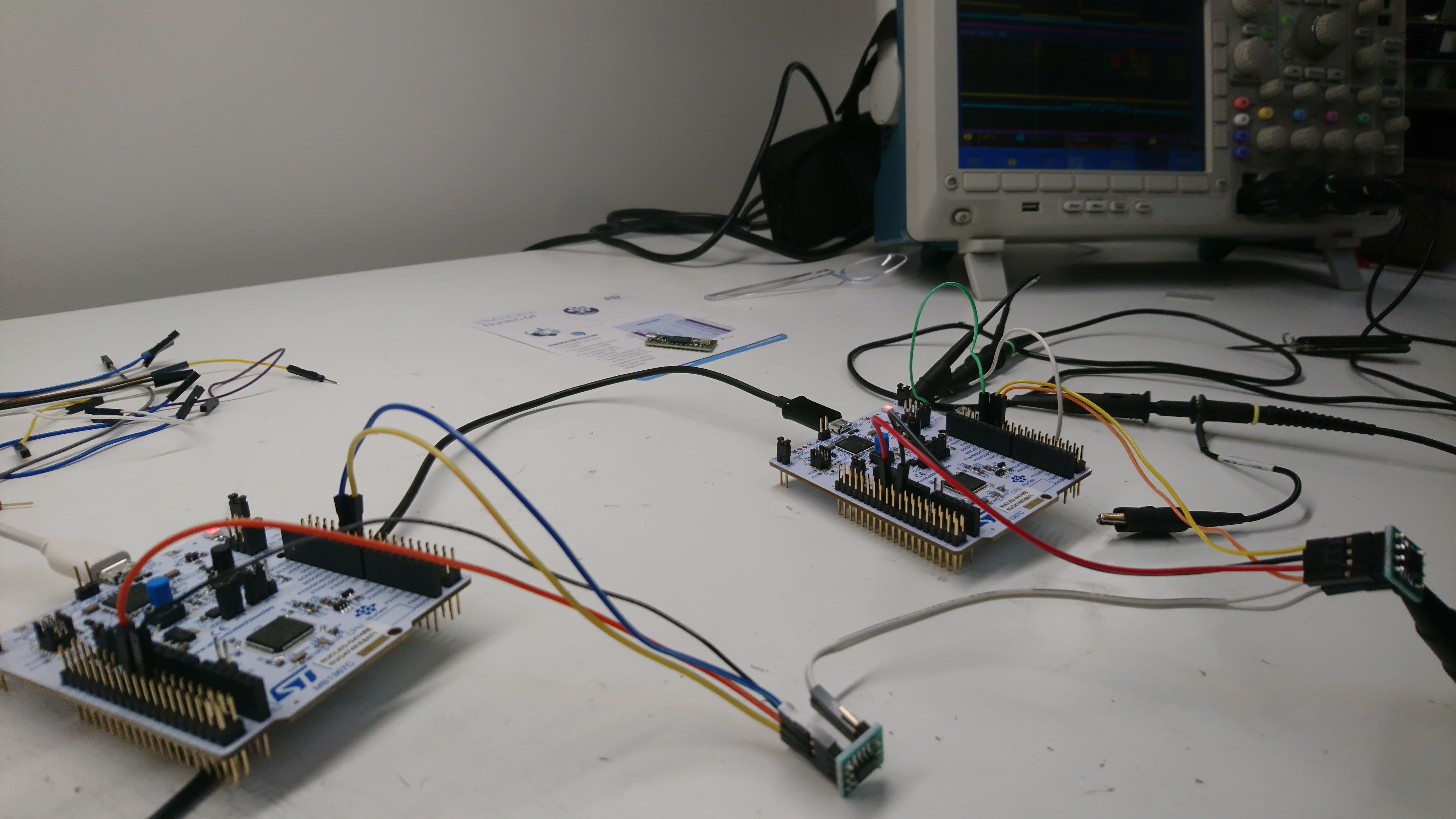
And then wired those up with a lot of jumper wires:

dsc_1555

After a fair amount of fiddling, bisecting against the ST CUBE example project, and fixing some problems with my STM32G4 support in rules_mbed, I ended up with some 16 byte CAN frames being sent and received with a data rate of ~4Mbit.