Archives: Dynamometer

Fitting moteus motor saturation models

Way back in 2020, I wrote about the motor saturation model that moteus uses to accurately calculate torque when a motor is operating in a region where the stator becomes saturated. What I didn’t write about was a method for actually determining those fit parameters for a given motor. This isn’t too critical, as most position mode applications don’t require the applied torque to be terribly accurate, but in some cases it does matter. When that is the case, there is now a tool that can calculate parameters appropriate for entering into moteus. Read on to find out more!
Improved dynamometer

Long ago, in a workshop not so far away, I built a dynamometer for characterizing moteus controllers and motors. In the intervening 5 years, we released the moteus-r4.11, moteus-n1, moteus-c1, and now the moteus-x1! For each of these controllers, and the many firmware releases in between, this fixture has still served as a critical part of the validation procedure for new firmware releases and new product releases. However, it was time for a few improvements when tackling the moteus-x1, so here is a brief write up of the new result.

Measuring torque ripple

Recently I described some changes I made to improve the low speed torque ripple of the moteus controlle. I also built a dynamometer. I decided to use the dynamometer to quantify how much things had improved with the torque ripple, and to see how much room for improvement was left with any anti-cogging implementation.

Dynamometer script

Here, the test script is relatively simple. I have the “fixture” controller sweep at a very low velocity (0.01Hz) through a bit more than one full revolution using a relatively high I term in the PID controller to ensure that it really holds that position no matter what external torque is applied. Then, the “device under test” controller is just commanded either to be powered off, or in position mode with a pd gain of 0 and a feedforward torque. Then I can just measure the result from the torque transducer while this sweeps through a full revolution, and correlate the measured torque with the encoder position.

Initial dynamometer assembly

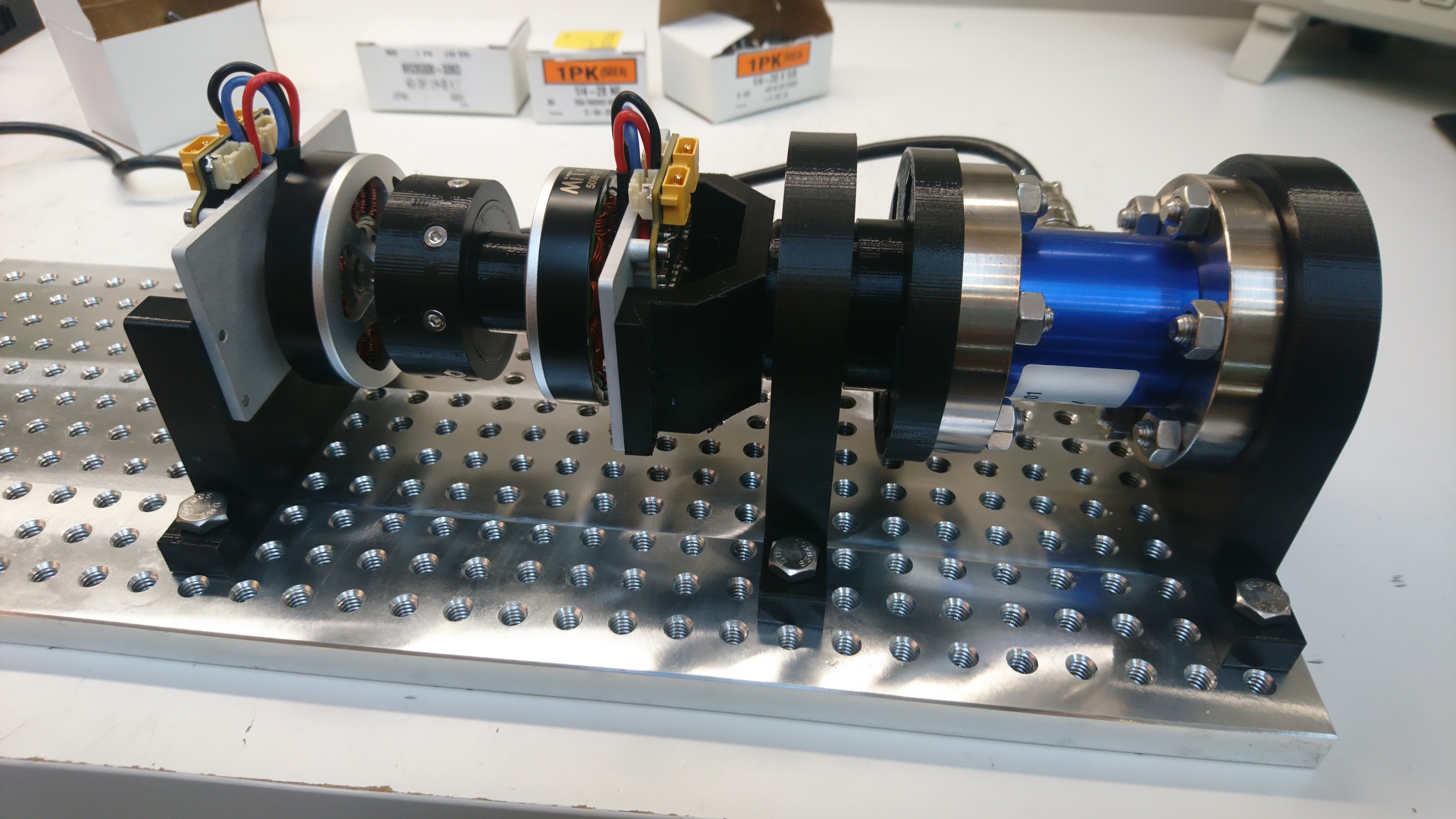
Earlier I showed off a torque transducer and the calibration fixture I used for it. I’ve now got enough assembled to make an entire dynamometer:

This has the torque transducer on one end, coupled to the “fixture” moteus controller through a bearing support. Then that is connected via a 3d printed coupler to the “device under test” moteus controller, which is hard mounted to the base plate. Any net torque between the two controllers will be coupled back to the transducer resulting in a measured torque.

Torque transducer

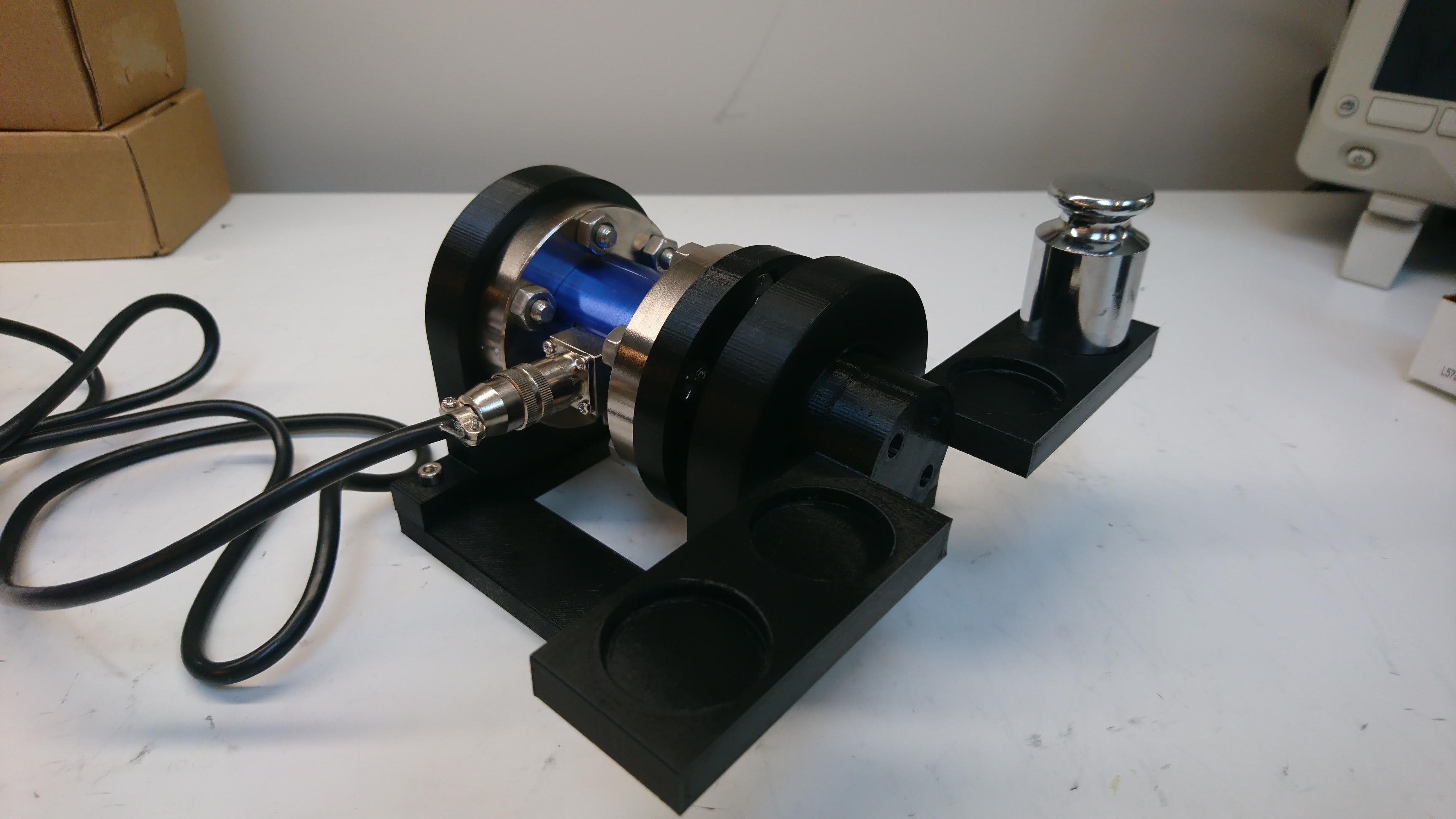
I’ve been wanting to build a dynamometer for a while to better characterize the performance of the direct drive and geared versions of the moteus controller. I have now started down that path with a torque transducer, which I calibrated with the below fixture:

I got a what ended up being a low quality load cell amplifier to use with it from the same supplier, although discovered it was total garbage and am now using a SparkFun OpenScale board which seems to be working much better. Soon I’ll hopefully have something wired up that actually has a controller or two on it.